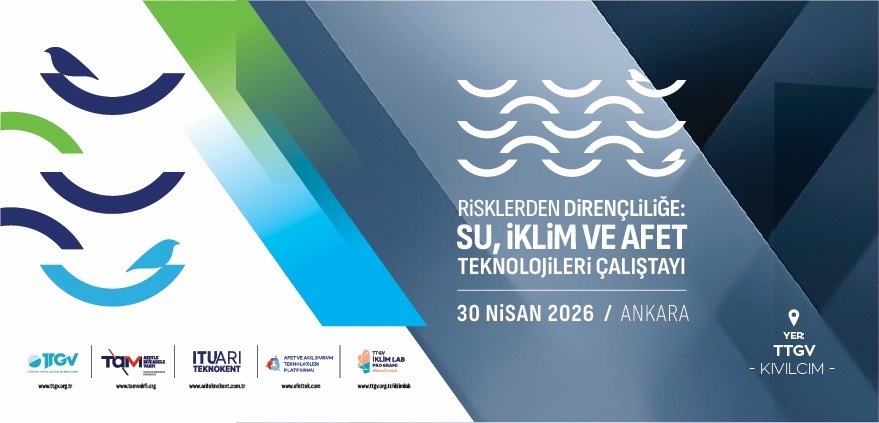
From Risks to Resilience: Workshop on Seeking Common Sense and Solutions for Water System-Related Disasters
On April 30, 2026, the “From Risks to Resilience: Water, Climate and Disaster Technologies Workshop,” organized in collaboration with the Turkish Technology Development Foundation (TTGV), the Disaster Management Foundation (TAM Foundation), and ITU Ari Technopark, was successfully held as an important platform addressing disaster risks related to water systems with a holistic approach. The workshop, attended by a total of 66 high-level participants, brought together the public sector, private sector, universities, civil society, and international organizations, offering a multi-stakeholder and inclusive discussion platform. Water Systems at the Center of Disaster Risks
The assessments made at the workshop clearly revealed that the effects of climate change are increasingly manifesting through water systems. It was emphasized that risks such as drought, floods, water scarcity, and deterioration in water quality are no longer isolated incidents but have transformed into chain-reaction disasters triggering each other. In a global environment where 2.1 billion people lack access to safe drinking water and water stress is rapidly increasing, it was stated that the pressure on water resources directly affects agricultural production, food security, and health systems.
Comprehensive Assessment in Three Key Thematic Areas
In-depth discussions were held under three main thematic headings within the scope of the workshop:
1. Identifying Critical Risks in the Water System
In the first session, key vulnerability areas such as drought, floods, water quality deterioration, infrastructure deficiencies, and data deficiencies were addressed. The fact that water is largely used in agriculture in Turkey and the inefficiency of this use stood out as a critical factor increasing the pressure on the system.
2. Technology Solutions and Prioritization
In the second session, technology solutions aimed at reducing these risks were evaluated. Areas such as data collection with sensors, satellite systems and remote sensing; prediction with artificial intelligence and modeling; intervention with smart irrigation and infrastructure solutions; and management with data platforms were determined as priority solution categories. It was emphasized that artificial intelligence, IoT, and data-driven technologies have high impact potential. 3. Policy and Governance Framework
In the third session, the necessary governance and policy mechanisms for the implementation of technology solutions were discussed. Lack of inter-institutional coordination, limitations in data sharing, and policy inconsistencies were identified as the main obstacles; while the integration of water management with agriculture and health policies, open data infrastructures, and the development of multi-stakeholder cooperation models were emphasized. Transition from Risk to Resilience: Shared Outcome
The most important outcome of the workshop was the strong consensus that water, climate, and disaster risks should be addressed not separately, but with an integrated systems approach. Participants stated that current intervention-oriented approaches are insufficient and that a shift to a risk prevention and resilience-oriented model is necessary. In this context, data-based decision support systems, early warning mechanisms, water efficiency technologies, and innovative financing models were considered priority areas. Contribution to the COP31 Process
It was stated that the findings and recommendations developed in the workshop formed a strategic basis that will contribute to Turkey's COP31 preparation process. Managing disaster risks related to water systems has emerged as a critical area that needs to be placed at the center of climate adaptation policies.
Acknowledgements
We would like to thank all stakeholders, especially the Turkish Technology Development Foundation (TTGV) and ITU Arı Technopark, who contributed to the realization of this important workshop; Dr. Ayşegül Selışık, FAO Turkey Deputy Representative, who added value to the workshop as a “keynote speaker”; and all participants who enriched the process with their contributions.
It is impossible to manage disasters without understanding water systems.
The solution for a resilient future starts with water systems.